
Summary
Highlights
The major DM central banks – Fed, ECB, BoE and BoJ - have left rates unchanged, in line with our expectations.
The Fed and ECB governors’ comments emphasized the importance of taking a “wait and see” approach.
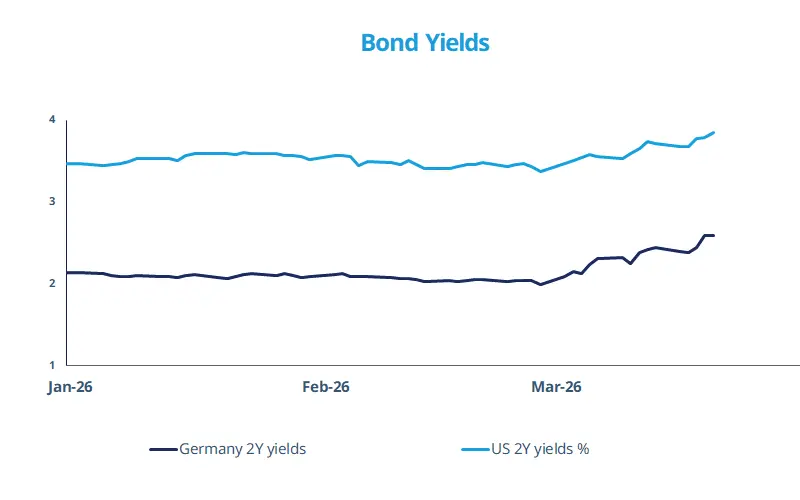
Bond-market movements have been significant: investors are now pricing in hikes for the ECB and the BoE, and no cuts for the Fed in 2026.
-
In this edition
Major central banks including, the Fed, the ECB and Bank of England held their policy rates unchanged in a week that saw escalation in the Middle East conflict. The conflict is also pushing up bond yields, as shown in the chart. While we believe the impact on inflation (from the crisis) will be slightly more pronounced in Europe, the common theme across central banks is that of keeping a ‘wait and see’ approach. This is because the duration for which energy prices stay high (and the crisis persists) could be the key factor for assessing the price pressures in the economy.
For the ECB, Christine Lagarde reassured that the bank is well positioned and equipped to deal with the war shock but she stressed that it is too early to draw firm conclusions about the economic impact of the Middle East conflict. Markets have also changed their expectations for rate cuts by central banks. We expect policy rates to remain largely stable in the very near term.
Key dates
Japan CPI, EZ PMI |
UK CPI and PPI, Germany IFO, US Import and Export prices |
EA CPI expectations, US University of Michigan Consumer Confidence |
Read more