- Overcaution: Investors may keep their savings in low-yield savings accounts rather than investing in financial markets. This behaviour is often driven by a fear of loss, stemming from an exaggerated perception of market risks, especially when they focus on the short-term performance of their portfolio.4
- Impulsive decisions: When the value of their shares fall, such as during a market downturn, investors may panic and fear further losses. As a result, they may rush to sell their shares.5

What is loss aversion?
Loss aversion refers to the phenomenon where the negative feelings caused by a loss are more intense than the pleasure experienced from gaining an equivalent amount.1
For example, the disappointment felt when losing €100 is stronger than the satisfaction of winning the same amount. Studies estimate that the negative emotional impact associated with a loss or a sacrifice is twice as powerful as the satisfaction felt when an equivalent gain is made.2
This stems from survival mechanisms where, situations perceived as negative and therefore potentially dangerous demand more urgent attention.3
Examples of loss aversion
When a company removes free coffee machines, employees’ complaints about losing the perk are far stronger than their initial appreciation when the machines were introduced. The removal, is perceived as a loss, often triggering a more intense emotional response than the positive reaction to the original gain.
Reluctance to leave a social circle: even if they don’t thrive in a social circle (friends, colleagues, members of a club etc.), some people are hesitant to leave out of fear of losing valuable relationships, opportunities or information. The fear of losing what they have, despite limited satisfaction, can often outweigh the potential benefits of leaving.
How loss aversion can affect investment decisions
How loss aversion can affect investment decisions

Time for action: overcome loss aversion in your financial decisions
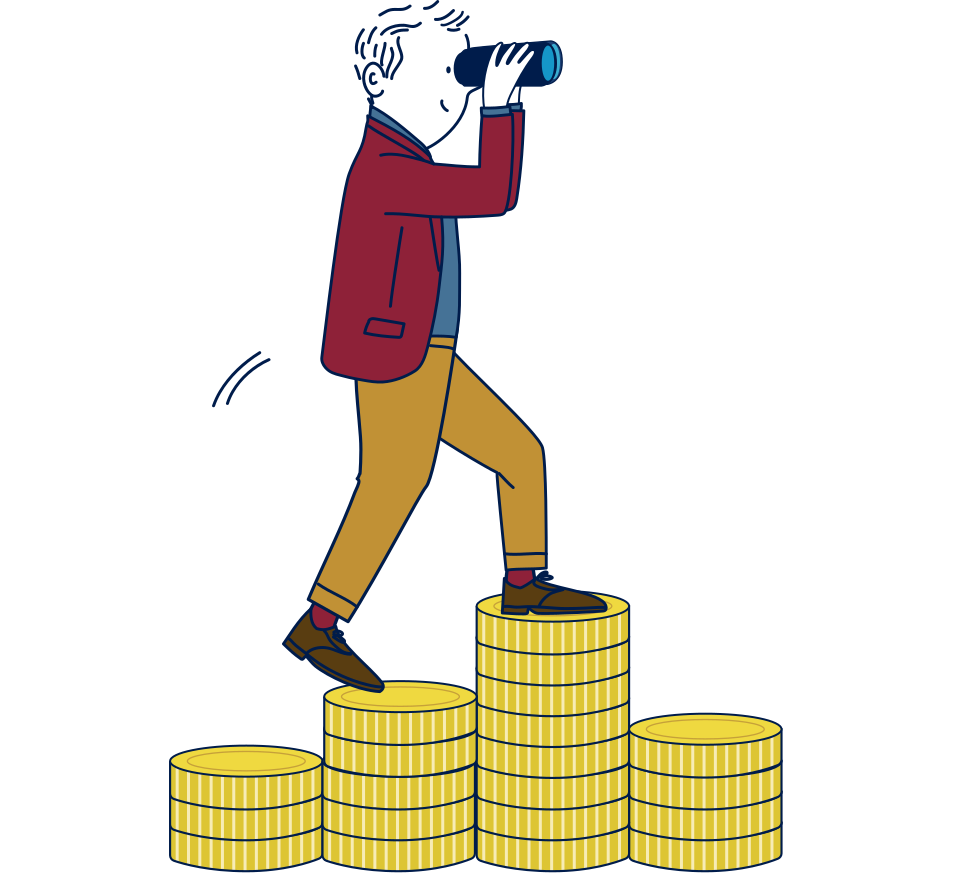
Time for action: overcome loss aversion in your financial decisions
Recognising the impact of loss aversion is the first step towards making better financial decisions.
Ask yourself these questions:
- Have I avoided investing in risky financial assets (such as shares)?
- Take a long-term view: the probability of incurring a loss is statistically lower over the long term.
- Diversify* your investments to limit risk and minimise the emotional impact if some of your investments decline in value.
- Did I sell a declining investment in a panic?
- Next time, avoid making impulsive decisions: take the time to assess the situation and consult a financial adviser if necessary.
*Diversification does not guarantee profit or protect against a loss.
Download the Infographic
The other chapters of the series are coming very soon!

Reason in action
A 6 part series on behavioural biases - those mental habits that unconsciously influence our decisions.

Why maintaining the status quo could be costing you more than you think
"Nothing ventured, nothing gained."
Proverb
Why maintaining the status quo could be costing you more than you think
"Nothing ventured, nothing gained."
Proverb
Why maintaining the status quo could be costing you more than you think
"Nothing ventured, nothing gained."
Proverb

Chapitre 5 : Jugements hâtifs : le piège caché dans vos décisions d'investissement
« Les apparences sont souvent trompeuses », dicton populaire

Chapitre 6 : Stratégies pour surmonter les biais comportementaux
Pourquoi est-il si difficile de les éviter ?
Illustrations : Cléo Wehrlin
1 Kahneman, Daniel, and Amos Tversky. (2013) Prospect theory: An analysis of decision under risk
2 Kahneman, Daniel, Jack L. Knetsch, and Richard H. Thaler (1990) Experimental tests of the endowment effect and the Coase theorem
3 Baumeister, Roy F., et al. (2001) Bad is stronger than good
4 The effect, known as myopic loss aversion, occurs when investors focus heavily on the short-term performance of their investments, causing them to overreact to short-term losses and potentially overlook long-term gains. As a result, a myopic investor suffering from loss aversion is likely to adopt a lower level of risk.
Thaler, Richard H., Amos Tversky, Daniel Kahneman, and Alan Schwartz (1997) The Effect of Myopia and Loss Aversion on Risk Taking: An Experimental Test
5 Barberis, Nicholas, and Ming Huang (2001) Mental accounting, loss aversion, and individual stock returns
Unless otherwise stated, all information contained in this document is from Amundi Asset Management S.A.S. and is as of 10 November 2025. Diversification does not guarantee a profit or protect against a loss. The views expressed regarding market and economic trends are those of the author and not necessarily Amundi Asset Management S.A.S. and are subject to change at any time based on market and other conditions, and there can be no assurance that countries, markets or sectors will perform as expected. These views should not be relied upon as investment advice, a security recommendation, or as an indication of trading for any Amundi product. This material does not constitute an offer or solicitation to buy or sell any security, fund units or services. Investment involves risks, including market, political, liquidity and currency risks. Past performance is not a guarantee or indicative of future results.
Date of first use: 10 November 2025
Doc ID: 4854427
Marketing Communication